
Problem statement
Conventional historiography on 17th-century Dutch paper accepts 1674 as the starting date of Pieter van der Ley's papermaking production. This date is consistently cited in specialized catalogues, watermark databases, and in Erik Hinterding's seminal work, Rembrandt as an Etcher (2006). However, a material and documentary contradiction exists that none of these sources has resolved or directly addressed. The WIRE Project (Watermark Identification in Rembrandt's Etchings), developed at Cornell University based on Hinterding's catalog, documents the countermark PvL.a Pieter van der Ley's double-wire initials in the following print:
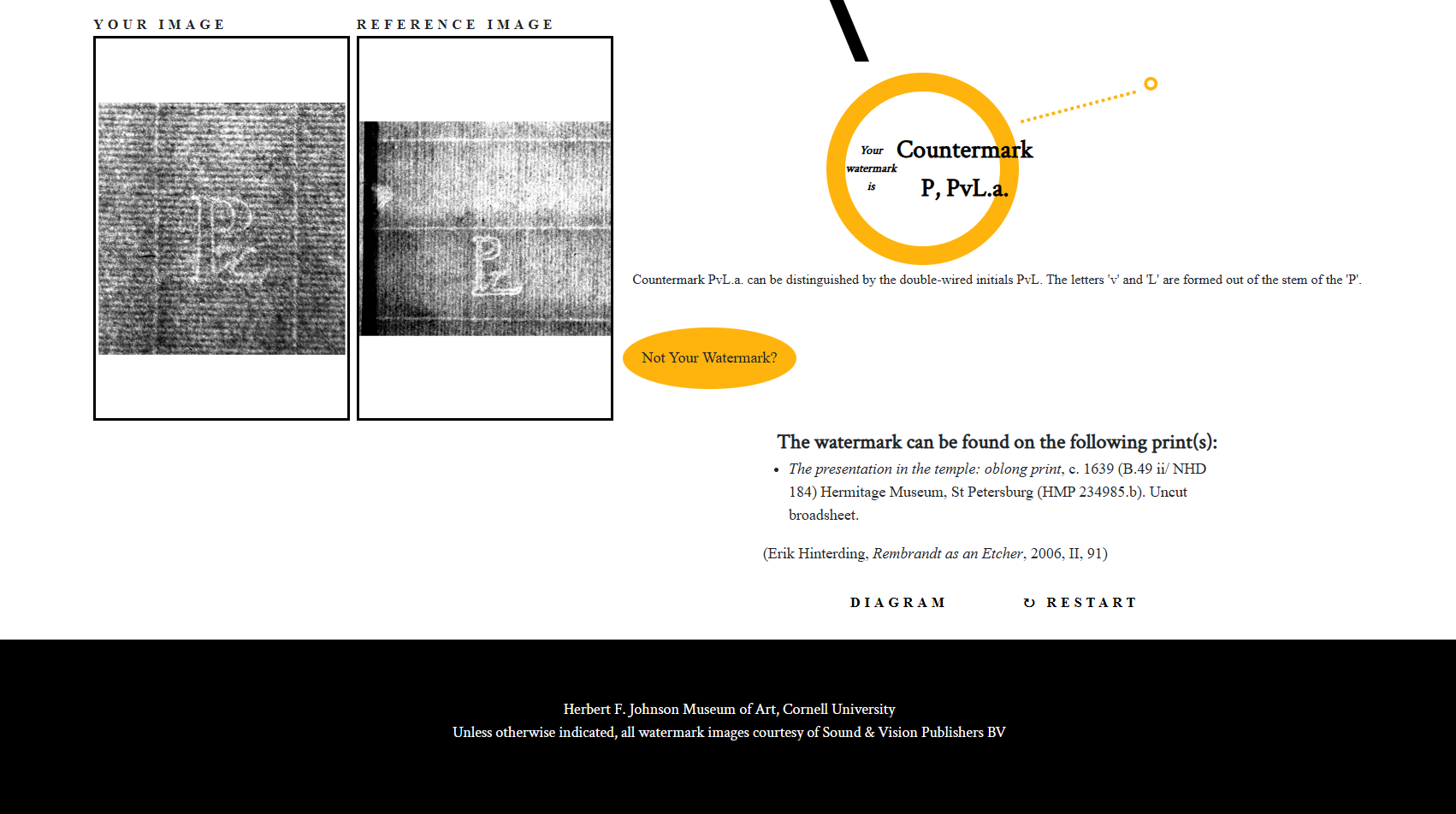
- The Presentation in the Temple: oblong print, c. 1639 (B.49 ii / NHD 184). Hermitage Museum, Saint Petersburg, HMP 234985.b.
- Complete uncut broadsheet. Source: Erik Hinterding, Rembrandt as an Etcher, 2006, vol. II, p. 91.
If Van der Ley paper production began in 1674, it is materially impossible that paper with the countermark PvL.a existed in 1639. This contradiction requires an explanation that the specialized literature has not provided.
The fundamental conceptual error: factory registration vs. family production
The root of the problem lies in a methodological confusion that has gone unnoticed: the date 1674 corresponds to the formal registration of Pieter van der Ley's manufacturing firm, not to the start of the Van der Ley family's paper production. These are two completely different historical realities. This distinction is crucial. In 17th-century Holland, artisan families produced and traded their goods for decades before formalizing a business. The legal registration of a manufacture was a late administrative act in relation to actual production activity.
Documentary evidence: the Van der Ley family has been making paper since 1605
Dutch primary sources, especially the Stichting Zaanse Papiergeschiedenis and the research of historian Ron Couwenhoven, exhaustively document the papermaking genealogy of this family:
1.The founder of the lineage: Pieter Jansz (Stijfselmaker), before 1605
The founder of the Van der Ley papermaking lineage is Pieter Jansz, known as Stijfselmaker, whose activity as a papermaker in Zaandijk is documented from before 1605. On March 8, 1605, in a transaction recorded by the scribes of the Banne in Westzaan, Pieter Jansz mortgaged his paper mill as collateral for a loan of 1,500 gulden, which proves that the mill already existed and was in operation prior to that date.
— Ron Couwenhoven, Stichting Zaanse Papiergeschiedenis.
Of extraordinary importance is the following fact: in 1597, Pieter Jansz signed documents with a personal house mark that later appeared as a watermark on Van der Ley family paper. In other words, the family's identifying graphic mark on paper has a documented origin in 1597, almost 77 years before the formally documented beginning of the Van der Ley firm in 1674. The Stichting Zaanse Papiergeschiedenis places that formal beginning on January 11, 1674, with the purchase of the De Wever and De Bonsem mills.
2.The sons of Pieter Jansz: papermaking activity documented in 1628, 1632 and 1636
Notarial documents from the Westzaan Banne record transactions concerning the mill in 1628 (in the name of Aerjen Pietersz), in 1632 (Gerrit Pietersz and Aris Pietersz sell parts of the mill), and in 1636, when Aeriaen Pietersz sells one-sixth of the mill to Cornelis Jansz. In 1639, the year associated by WIRE/Hinterding with the PvL.a countermark printing, the Van der Ley family's paper business had been documented for more than three decades, with records prior to 1605 and subsequent transactions in 1628, 1632, and 1636.
3.Gerrit Pietersz. van der Ley (1602–1674): the bridge to white paper
It was Gerrit Pietersz. van der Ley (1602–1674), grandson of the founder, who, in 1674, the last year of his life, established the foundation of the white paper industry that would bring fame to the firm. Together with the De Zwarte Bonsem and De Wever mills, he shifted production towards high-quality writing and printing paper. This is the moment that historians have mistakenly identified as the origin of the family, when in reality it was merely the formalization of an activity that had been ongoing for three generations.
The meaning of the Hermitage print with PVL.a
The print documented by Hinterding and Project WIRE presents two physical characteristics of utmost relevance for dating:
- It is an uncut sheet (broadsheet). This is physically significant because, as documented in scholarly literature, the usual practice after Rembrandt's death was to trim the prints to the edge of the plate's imprint. An uncut, intact sheet constitutes relevant material evidence and is compatible with an early printing, especially when considered together with the countermark, the condition of the sheet, and the documentary chronology of the paper.
The presence of the PvL.a countermark on paper used around 1639 is perfectly consistent with the documented history of the family: at that time, Pieter Jansz's sons and grandsons had been producing paper in Zaandijk for decades under the family brand.
The question that historiography does not answer
The chronological contradiction is known to specialists. Project WIRE, which has as one of its stated objectives distinguishing Rembrandt's lifetime prints from posthumous ones, catalogs this print without resolving or even raising the incompatibility between the date of the countermark PvL.a and the official Van der Ley start date of 1674. The direct question is: Why has 1674 been used as the absolute start date of Van der Ley paper production when there is material evidence—a PvL.a countermark on paper linked to 1639—and documentary evidence demonstrating this family's papermaking activity from before 1605? The most likely answer, in light of the available documentation, is that 1674 is simply the date of the formal registration of the manufacturing company, and that it has been systematically used as if it were the date of the start of production, ignoring more than six decades of documented family papermaking history.
Consequences for the dating of Rembrandtian prints
If it is accepted that the Van der Ley family produced paper with their identifying mark from at least 1605, and that Rembrandt used that paper around 1639, the following consequences for the history of art follow:
- The Hermitage print (HMP 234985.b) of The Presentation in the Temple, c. 1639, countermarked PvL.a on a full uncut sheet, should be considered an early print, consistent with Rembrandt's lifetime, and not a posthumous print.
- The dating of other Rembrandt prints bearing the PvL.a countermark should be revised in light of this corrected chronology.
- The cataloging of prints as posthumous based exclusively on the 1674 date of the Van der Ley signature registration is methodologically untenable.
Conclusion
The evidence is clear and documented in publicly accessible Dutch primary sources. The Van der Ley family was manufacturing paper in Zaandijk before 1605, with a personal identifying mark documented since 1597. The date of 1674 corresponds solely to the formal registration of the manufacturing firm, not to the start of the family's paper production. The countermark PvL.a on a full, uncut sheet of Rembrandt's 1639 plate is not an anomaly. It is material evidence consistent with the true history of this family, which scholarly historiography has ignored by reducing the origin of Van der Ley paper to an administrative date. This chronological review has direct implications for the authenticity and dating of Rembrandt prints that are currently cataloged as posthumous for reasons that, in light of the documentation, are methodologically insufficient if they are not confronted with the material evidence of the sheet, the countermark, and the documentary chronology of the Van der Ley papermaking family.
Sources and references
Sources and references
- Erik Hinterding, Rembrandt as an Etcher: The Practice of Production and Distribution, Sound & Vision Publishers, 2006, vol. II, p. 91.
- WIRE Project (Watermark Identification in Rembrandt's Etchings), Herbert F. Johnson Museum of Art, Cornell University. Countermark database, type PvL.a.
- Henk Voorn, De papiermolens in de provincie Noord-Holland, 1960, p. 535.
- Ron Couwenhoven, "Papiermolen Pieter Jansz van der Ley", Stichting Zaanse Papiergeschiedenis, zaansepapiergeschiedenis.nl.
- Stichting Zaanse Papiergeschiedenis, "De Zwarte Bonsem" and "De Wever", zaansepapiergeschiedenis.nl.
- Historische Vereniging Koog-Zaandijk, "Lagedijk 96 in Zaandijk", historischeverenigingkoogzaandijk.nl.
- Wikipedia (DE), "Pieter van der Ley", with references to the Journal für Fabrik, Manufaktur, Handlung, Kunst und Mode, Leipzig, 1797.
- C. Richard Johnson Jr., "Decision Trees for Watermark Identification in Rembrandt's Etchings", Journal of Historians of Netherlandish Art 12:2, Summer 2020.
- The Nieuwsbrief of the Honig Breethuis (2019) specifies it with an exact date: "Op 11 januari 1674 koopt hij de molens 'De Wever' en 'De Bonsem'. Dit vormt de start van de firma PIETER VAN DER LEY." Honigbreethuis .
- The Stichting Zaanse Papiergeschiedenis confirms: "Deze koop vond al snel plaats nl. op 11 januari 1674", and adds: "Hiermee begon de firma Van der Leij als een van de eerste in de Zaan met de productie van wit papier." Zaansepapiergeschiedenis .
- Stichting Zaanse Papiergeschiedenis / Pier van Leeuwen (Honig Breethuis), "Zaans witpapier: een wereldproduct", Archief Zaanstad, archief.zaanstad.nl/nieuws/nieuwsberichten/329-zaans-witpapier-een-wereldproduct.
- Ruben Schalk, "Apprenticeships and craft guilds in the Netherlands, 1600–1900", Working Paper 0080, Utrecht University, Centre for Global Economic History, 2016, ResearchGate publication/310365470.
Appendix I.
Seymour Haden's principles of connoisseurship on dating Rembrandt's impressions (1879)
This appendix presents the methodological principles formulated by Sir Francis Seymour Haden (1818–1910) in his work About Etching (The Fine Art Society, London, 1879). Haden was the foremost collector and expert on Rembrandt prints of his time, and also the author of the first systematic catalogue raisonné of the master's etched work (The Etched Work of Rembrandt, 1877). His principles do not constitute direct evidence regarding the PvL.a countermark or the Hermitage print, but they establish the framework of 19th-century connoisseurship within which the question of dating prints was already recognized as a complex problem, irreducible to the date inscribed on the plate.
A.1 On the relationship between states and impressions (Note XII)
In Note XII of About Etching, entitled “States”, Haden establishes as a general principle of connoisseurship:
This principle, formulated by the leading specialist of his time, underscores that identifying a print as early or late cannot be done simply by referring to the condition of the plate, but requires analysis of the material evidence, including the paper and its markings. It methodologically supports the central argument of this work: that the PvL.a countermark on a full, uncut sheet is material evidence of an early print, and that its dating cannot be determined solely by relying on the administrative date of the Van der Ley factory's registration.
A.2 On the relationship between signature, date and time of execution (Note XIII)
In Note XIII, entitled “Signatures and Dates”, Haden directly addresses the issue of dating plates and prints:
This principle has direct methodological application to the present debate: if the date engraved on a printing plate does not necessarily indicate the moment of its creation or its first printings, then, even more so, the date of the official registration of a paper mill cannot be used as an absolute limit for the existence of paper bearing its countermark. The Van der Ley family was producing paper in Zaandijk before 1605. The fact that their mill was formally registered in 1674 does not retroactively determine the date of the start of its production or its trademarks.
A.3 Bibliographic reference
Francis Seymour Haden, About Etching. Part I. Notes by Mr. Seymour Haden on a collection of etchings and engravings by the great masters. Part II. An annotated catalog of the examples exhibited of etchers and painter-engravers' work. The Fine Art Society, 148 New Bond Street, London, 1879 (4th edition).