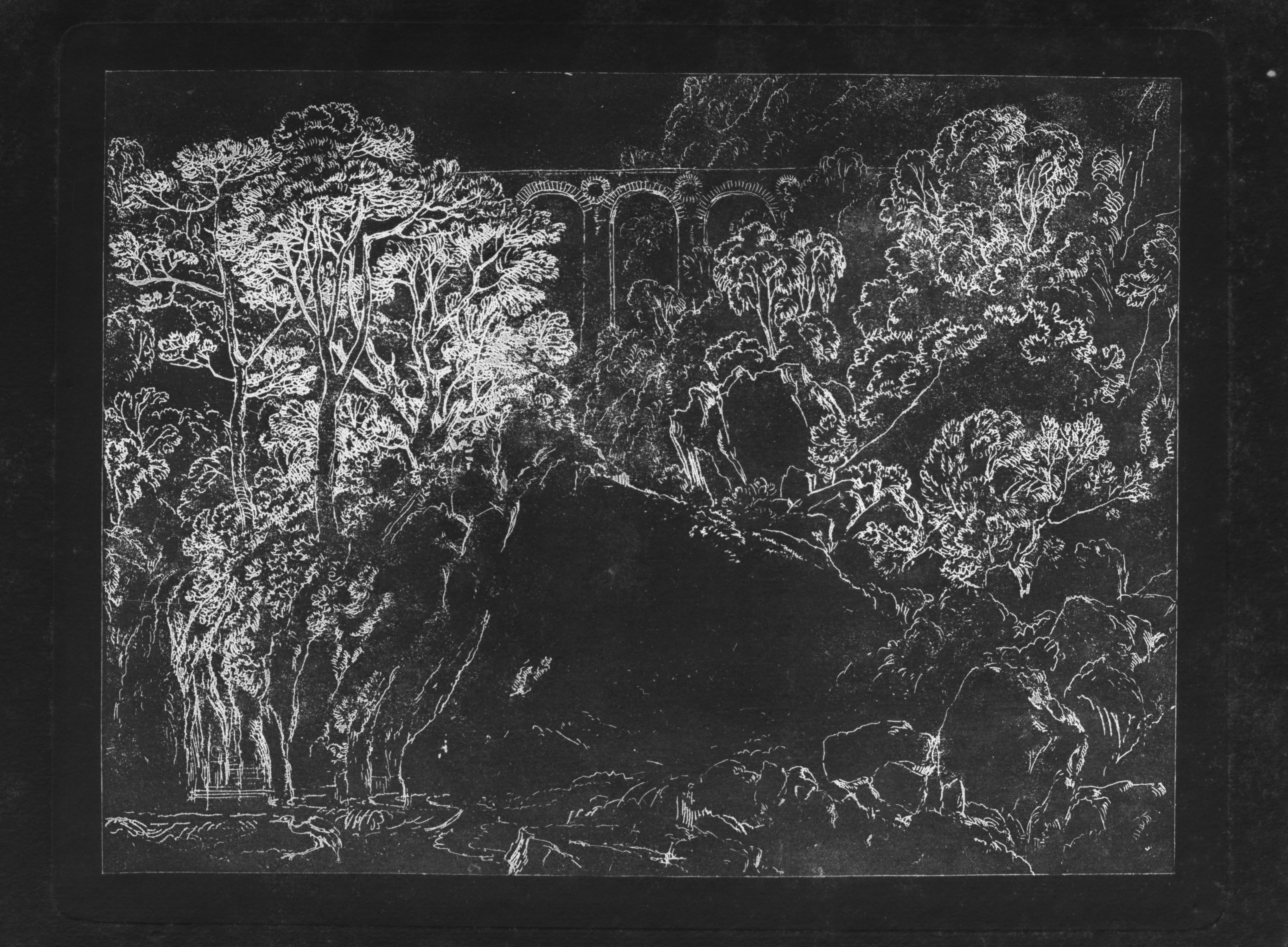
The Stork and Aqueduct — J.M.W. Turner (Liber Studiorum, Plate 83)
Technical documentation of the print through direct material observation, including paper structure (laid pattern and chain lines), ink–fiber interaction, plate mark under raking light, line morphology under macro/microscopy, ultraviolet response (365 nm), and tonal mechanism analysis. Comparative side-by-side and overlay analysis against an institutional reference impression.
TECHNICAL DATA
- File ID
- AC-WT-247-REV-2026
- Artist
- Joseph Mallord William Turner (1775–1851)
- Title
- The Stork and Aqueduct (Liber Studiorum, Plate 83)
- Date of Execution
- About c. 1820
- Technique / Materiality
- Etching on ivory laid paper.
- Dimensions
- Height 251 mm × Width 187 mm
- Sheet Dimensions
- Height 316 mm × Width 250 mm
- Sheet Weight
- 17 grams
- Collection
- The Álvarez Collection (Miami)
- Provenance
- Private family collection, preserved over generations
Research Objective
Technical documentation of the print through direct material observation, including paper structure (laid pattern and chain lines), ink–fiber interaction, plate mark under raking light, line morphology under macro/microscopy, and tonal mechanism analysis. Comparative overlay analysis, and observation of organic degradation phenomena.


PAPER ANALYSIS
Support, Structure, and Material Composition
The print is executed on a laid paper produced by hand mould, as confirmed through transmitted light, microscopic examination, and ultraviolet observation. The sheet measures approximately 316 × 250 mm and has a recorded weight of 17 grams, corresponding to a relatively substantial historical printing paper consistent with intaglio use.
Laid structure and chain lines
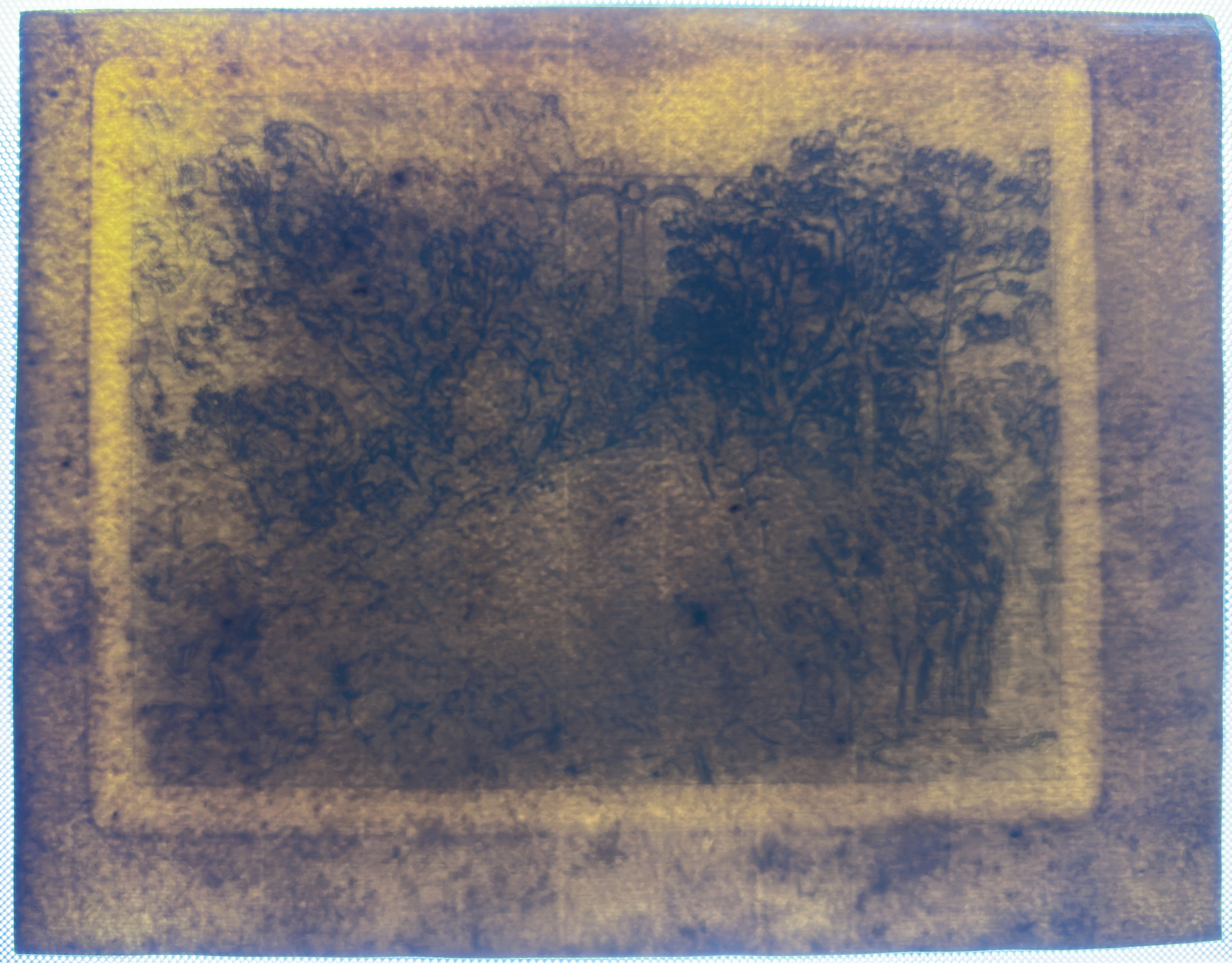
Transmitted-light examination reveals a clearly defined laid paper structure, with a regular system of chain lines spaced at approximately 25 mm. The chain lines are straight, evenly distributed, and continuous across the sheet, indicating formation on a traditional laid mould rather than a wove or hybrid support. No evidence of later re-lining, backing, or composite construction is observed.
Fiber structure and intrinsic inclusions
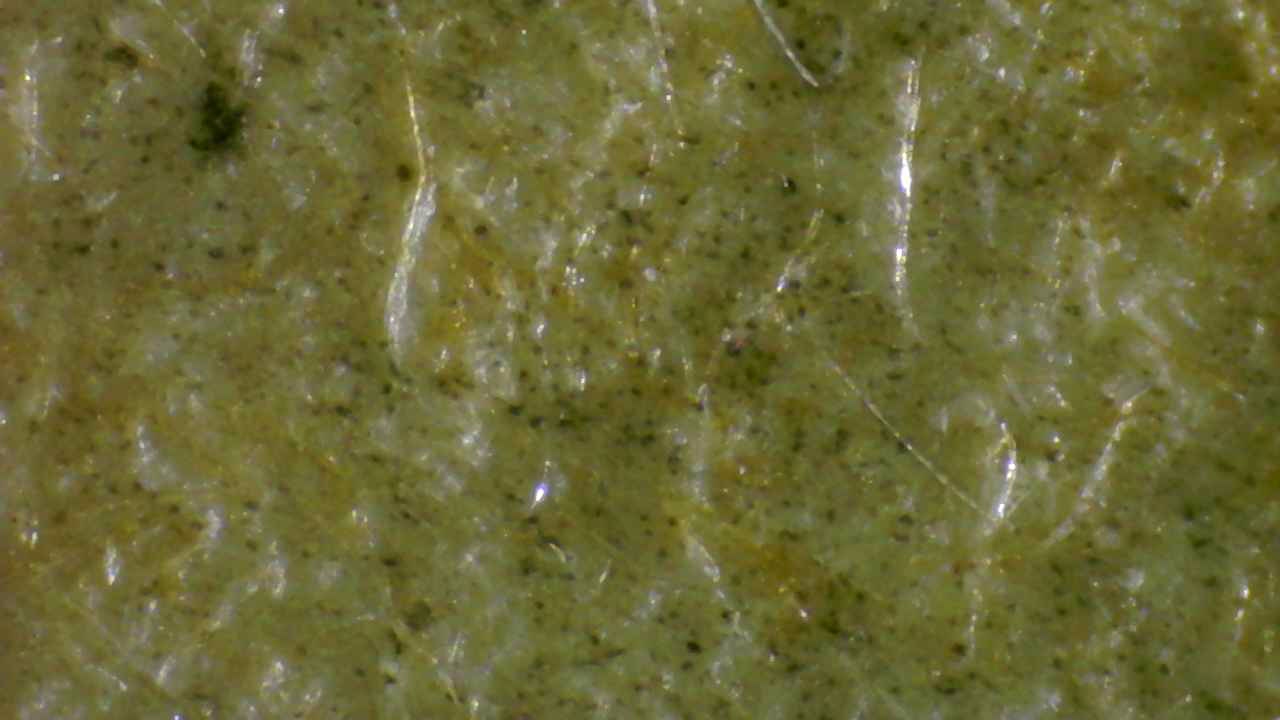
Microscopic examination of the paper reveals an interwoven network of long, irregular fibers consistent with handmade rag paper. Within this fiber matrix, numerous small dark inclusions are visible. These inclusions are embedded between fibers rather than resting on the surface, indicating that they are intrinsic to the paper pulp rather than later contaminants such as dust or handling debris. Their distribution and integration are consistent with historical hand-formed paper.
Surface behavior and interaction with ink
The paper surface shows natural irregularity and micro-relief typical of hand-formed sheets. Ink interaction is coherent with this structure: ink penetrates and settles according to fiber orientation and local compression, without evidence of surface coating, sizing anomalies, or later intervention. There is no indication of applied grounds, fillers, or preparatory layers.
Ultraviolet examination (365 nm)
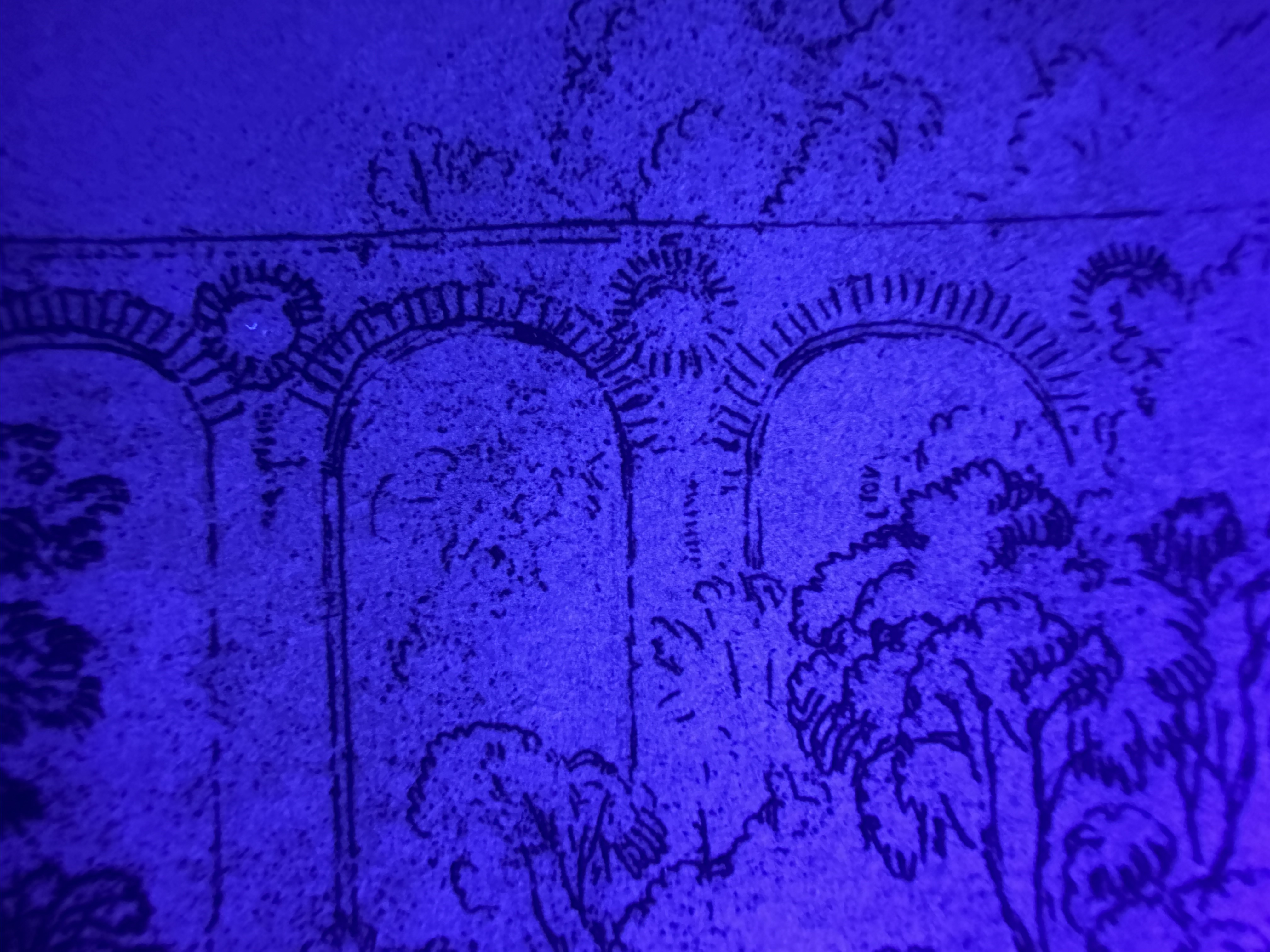
Under UV-A illumination (365 nm), the paper exhibits a uniform, subdued fluorescence across both printed and unprinted areas. No bright blue or white fluorescence associated with optical brightening agents is observed. The ink remains dark and stable under UV, without differential fluorescence patterns suggesting later retouching, chemical alteration, or modern coatings. The embedded inclusions remain non-fluorescent, consistent with their intrinsic presence within the fiber network.
The embedded dark inclusions remain non-fluorescent under UV, further confirming their intrinsic nature within the paper structure. The ink appears dark and stable, without halos, migration, or differential fluorescence that would suggest later retouching, washing, or chemical alteration.
Conclusion
All observed characteristics—laid structure with ~25 mm chain lines, rag fiber morphology, intrinsic embedded inclusions, and stable UV response— are fully coherent with a historical handmade laid paper intended for intaglio printing. The paper shows no evidence of modern manufacture, later alteration, or composite construction. All observations are derived directly from material examination.

MACROGRAPHIC ANALYSIS
The macrographic examination presented in the following figures documents the material construction of the plate through magnified observation of line behavior, ink deposition, relief, and surface texture. Each image is analyzed in isolation, allowing the physical relationship between incised contours, dispersed ink deposits, and the paper surface to be examined without presupposition.
Close inspection confirms a consistent graphic system dominated by linear articulation. Structural elements are defined through irregular, variable-width incised lines with localized ink retention and perceptible relief. Surrounding areas do not form continuous tonal grounds; instead, they display scattered, non-uniform ink deposits that remain discontinuous under magnification and do not coalesce into a homogeneous granular matrix.
Across all examined zones—including foliage, architectural elements, tree structures, and sky—the paper texture remains clearly visible. Tonal effects arise from the density and interaction of lines and localized ink accumulation rather than from an autonomous or mechanically uniform tonal field. Line and non-linear deposits function together compositionally but retain distinct material behaviors at the surface level.
In addition, a subtle tonal shift is observable within the printed field, confined to the area of the plate. The paper outside the plate mark retains a lighter, natural tone, indicating that this tonal variation corresponds to ink presence within the printed surface rather than to the support itself. This observation is recorded descriptively, based solely on visible surface characteristics.
Conclusion.
Taken together, the macrographic evidence demonstrates a unified graphic system in which form and tone are constructed through linear incision and localized ink deposition, without the presence of a continuous or structured granular tonal ground in any of the examined areas. The consistency of line behavior, surface relief, and ink–paper interaction across all figures indicates material coherence throughout the plate. These observations are grounded exclusively in direct visual examination and establish a descriptive baseline for the object, without recourse to historical, stylistic, or process-based interpretation beyond what is materially observable

Detail showing the structural etched lines forming the tree trunks and branches. The lines display variable width, irregular edges, and concentrated ink retention within the bitten grooves, consistent with intaglio etching. The surrounding darker points do not form a continuous tonal field. Instead, they appear as irregular, dispersed deposits of ink across the paper surface. No homogeneous granular matrix characteristic of a fully developed mezzotint ground is visually confirmed in this zone. The tonal effect in this area derives primarily from the density of etched lines and localized ink retention rather than from a structured mezzotint grain.

Detail of the stork, the primary compositional anchor of the plate. The figure is constructed predominantly through fine etched lines without tonal modelling. The absence of mezzotint within the body of the bird emphasizes its structural clarity against the surrounding tonal landscape.
.jpg)
Detail of the aqueduct arches defined by fine, irregular linear incisions that function primarily as structural contours. The image is organized through open, delineating lines with variable width and localized discontinuities. Relief is confined to the inked lines, while the surrounding paper surface remains largely uninterrupted and textured.
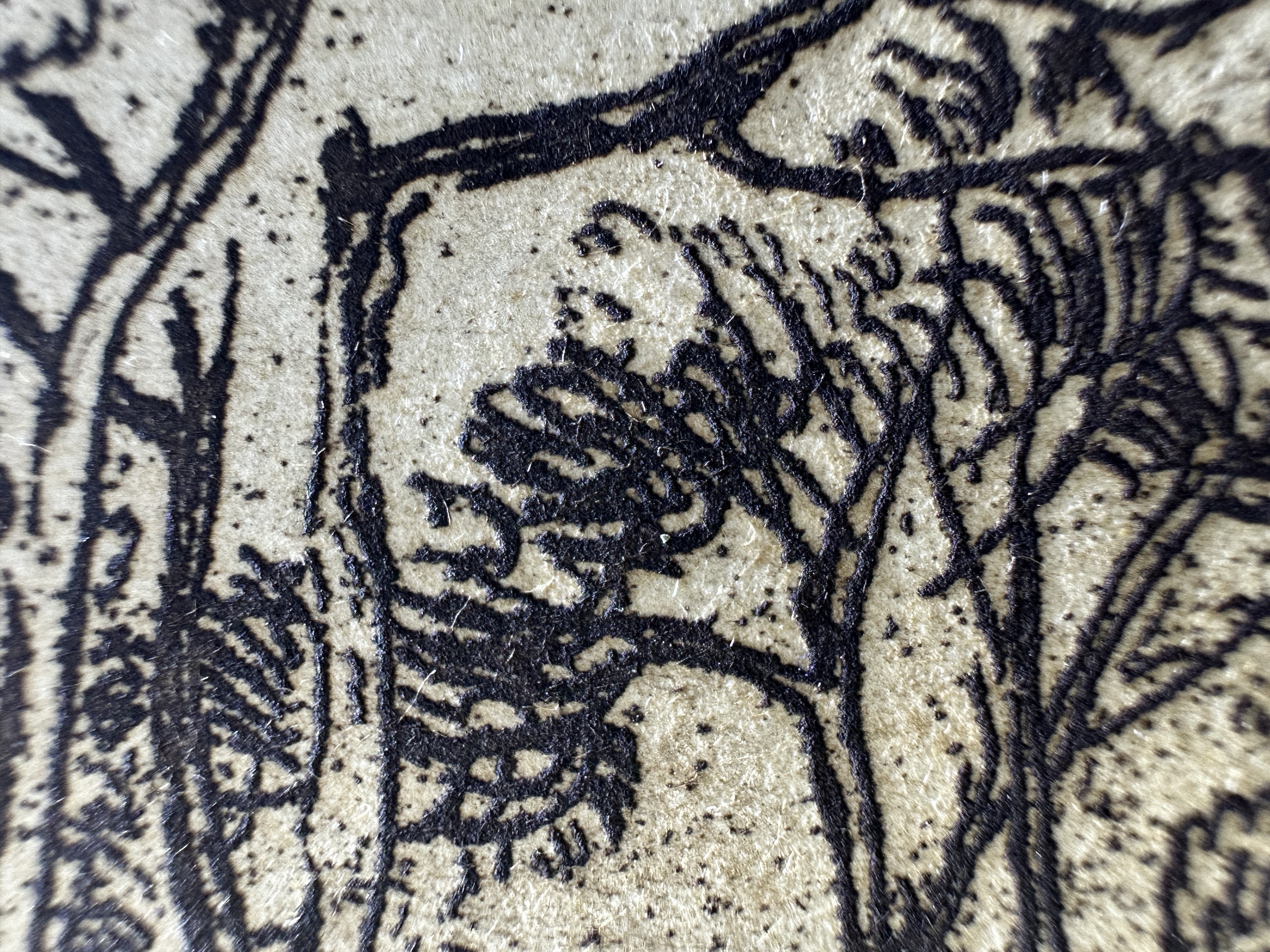
Detail showing a dense network of irregular, intersecting lines that accumulate to construct organic form. The image relies on overlapping and directional shifts of line, with frequent changes in width and continuity. The paper surface remains visible between the lines, but the increased linear density produces a compact visual field with localized relief throughout the inked areas.
.jpg)
Detail showing irregular curving lines defining organic forms, combined with areas of increased ink density. The image exhibits variable line width, frequent interruptions, and overlapping traces. The textured paper surface remains visible throughout, with localized relief associated with inked areas and a gradual, porous transition between ink and paper.

Detail of the sky area showing a predominantly open paper surface with scattered, irregular ink deposits. The darker points are non-uniform in size and distribution and do not form a continuous or homogeneous granular field. Linear marks remain sparse and discontinuous, and the paper texture is clearly visible throughout, indicating tonal effect derived from dispersed ink presence rather than from a structured tonal matrix.
MICROSCOPIC SURFACE ANALYSIS
Microscopic examination was undertaken to document the physical behavior of the engraved lines and their interaction with the paper support at a scale beyond macroscopic visibility. The purpose of this analysis is not to restate compositional features, but to observe how individual marks are materially formed, how ink is retained within them, and how these behaviors vary according to their visual function within the work.
The work is constructed exclusively through linear incision and accumulation of strokes, with controlled variations in density, depth, and orientation. No autonomous tonal field or organized granular matrix compatible with mezzotint is observed.
At high magnification, attention is directed to the presence or absence of structured microscopic fields, the continuity or fragmentation of incised lines, and the manner in which ink responds to the underlying fiber network of the paper. This approach allows linear construction, surface relief, and ink deposition to be examined independently from visual tone as perceived at normal viewing distance.
All observations are derived exclusively from the object under magnification. No assumptions are made beyond what is materially observable at the microscopic level.

High-magnification micrographic view of the stork’s head showing a dominant incised channel used to define a critical anatomical feature. The channel exhibits irregular lateral edges and localized depth variation, with ink concentrated in the deepest areas and partially interrupted by visible paper fibers. Ink retention is most pronounced in the eye region, where channel geometry produces increased visual density without reliance on a surrounding tonal field.
.jpg)
Micrographic view of the tree trunk structure revealing a series of continuous incised channels arranged in parallel. The channels vary subtly in width and depth, creating directional structure through repetition rather than focal emphasis. Ink is retained primarily within the channels and adapts to the fibrous network of the paper, while adjacent areas show only isolated, non-structured ink deposits.
.jpg)
High-magnification micrographic view of the foliage area showing a dense network of short, multidirectional incised channels with highly variable width and depth. Ink is retained within the channels and interrupted by visible paper fibers, producing areas of increased visual density through accumulation rather than through a continuous tonal plane.
.jpg)
High-magnification micrographic view showing an isolated ultra-fine incised line with clearly perceptible relief, evidenced by a continuous shadow cast along the trace under directional illumination. Ink follows the incised path and is locally interrupted by visible paper fibers. The surrounding area shows only sparse, isolated ink deposits, without formation of an organized microscopic field.
COMPARATIVE STRUCTURAL ANALYSIS
Line-Based Construction versus Tonal Field
The following comparative panels present a direct visual analysis between the examined impression and an institutional reference impression from the Indianapolis Museum of Art (Newfields), accession no. B1977.14.13968. The side-by-side view allows immediate assessment of the presence or absence of an autonomous tonal field. A 1:1 structural overlay tests alignment of engraved lines and overall plate structure, while a localized overlay focuses on the stork and aqueduct zone to examine line correspondence in a region where tonal techniques, when present, are readily observable.
The images are presented to allow independent visual verification of material differences. No conclusions are imposed beyond what is directly observable in the comparative material.
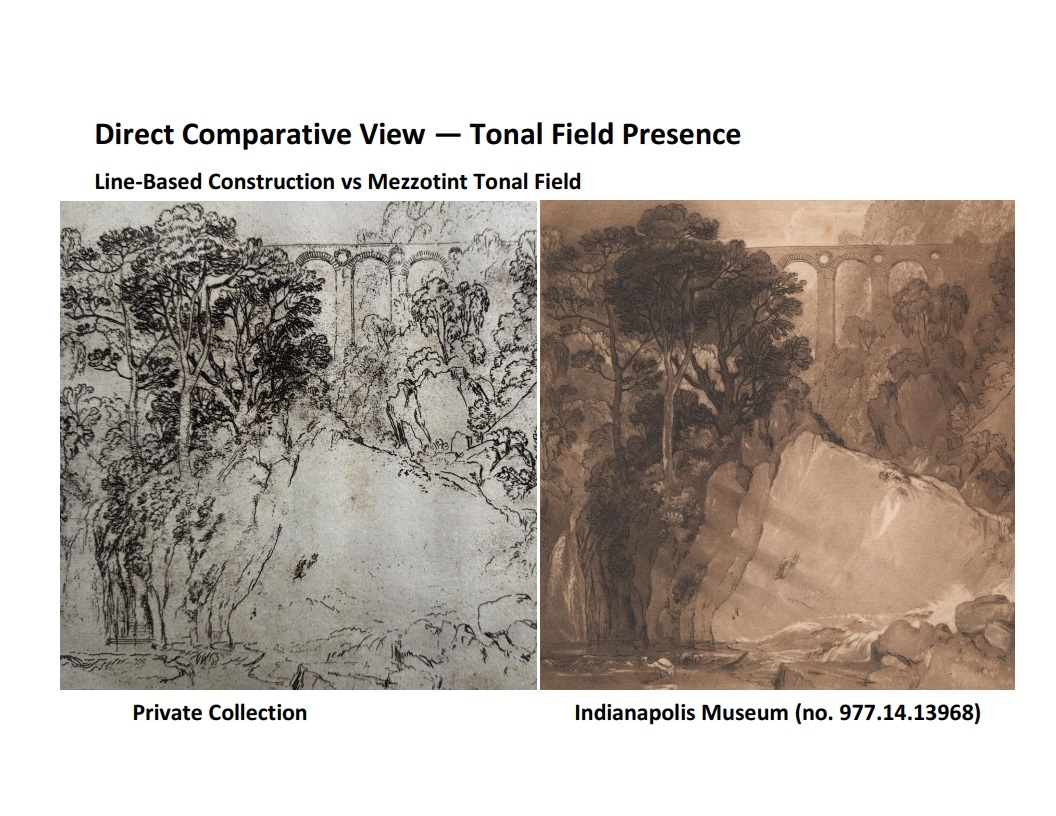
Line-Based Construction vs Mezzotint Tonal Field. Left: Private Collection (examined impression). Right: Indianapolis Museum of Art (Newfields), accession no. B1977.14.13968.
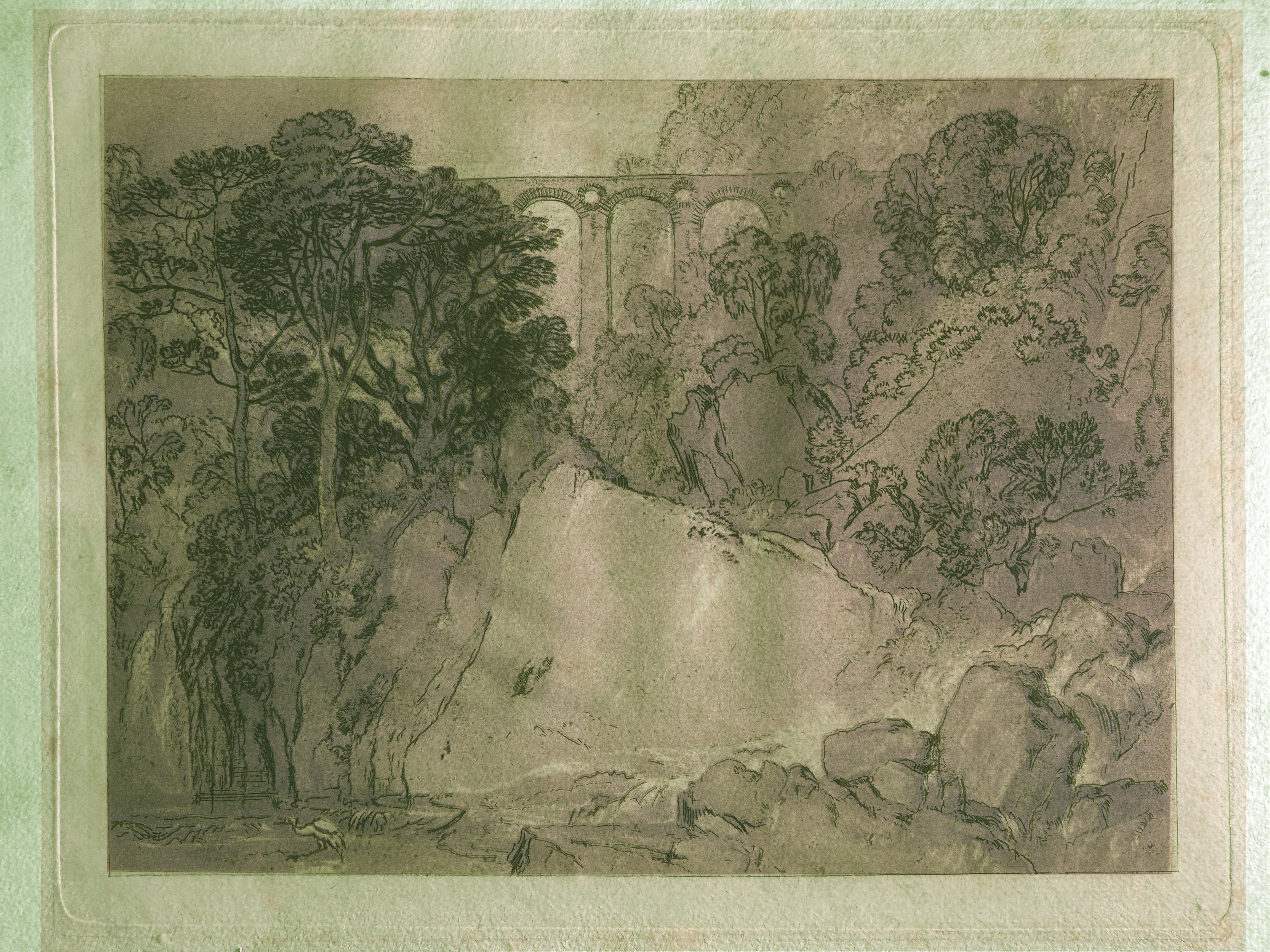
Alignment of principal engraved lines confirms structural correspondence between the examined impression and the institutional reference.
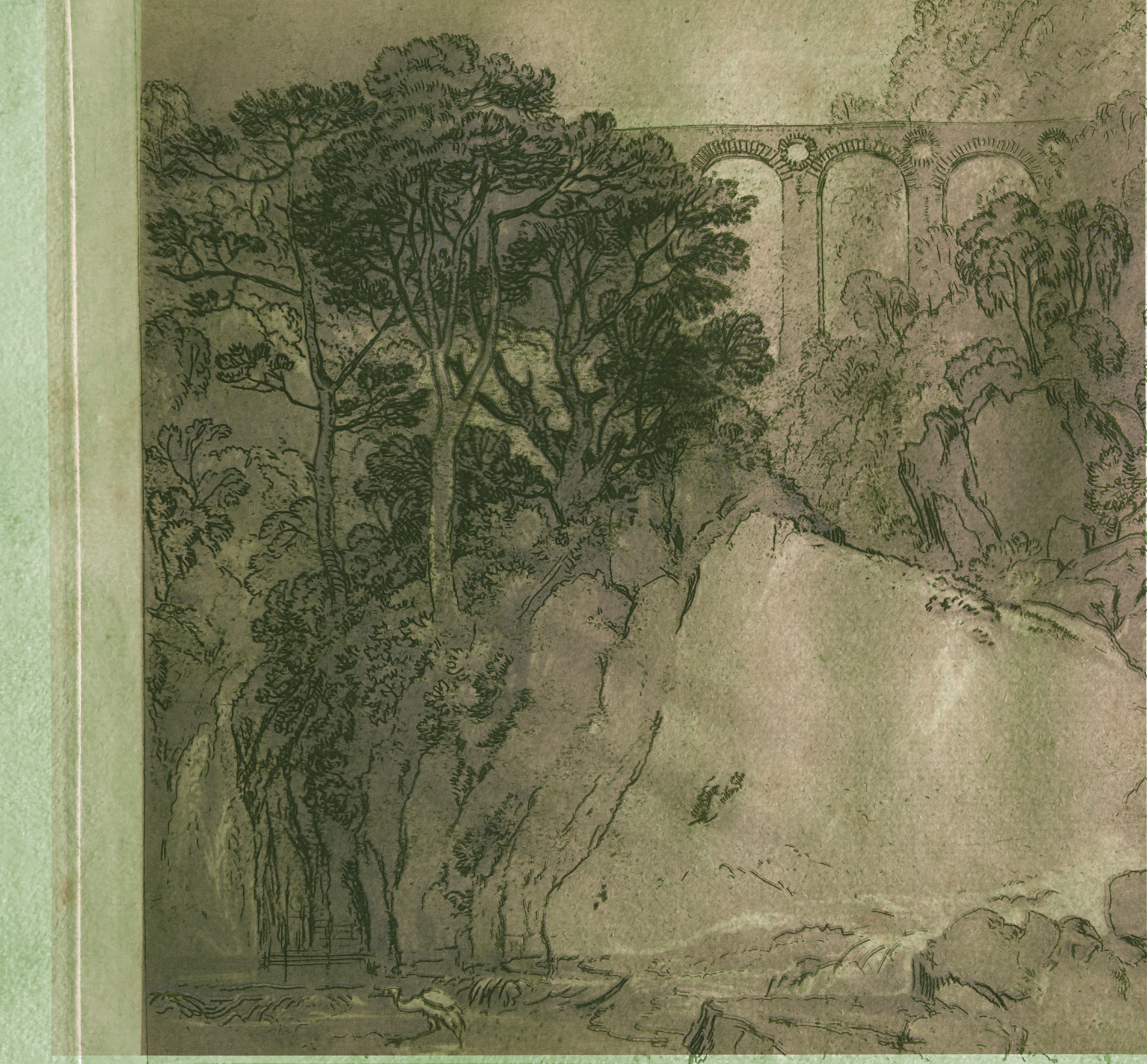
Detail overlay focused on the stork and aqueduct area, used to verify line-level correspondence within a confined structural region.
Provenance and History
The print was transmitted from generation to generation, remaining within the same family. Its state of preservation suggests minimal historical handling: it was stored for decades in a protected environment, away from direct light and damaging humidity fluctuations. It is likely that the print has been handled far less during the past one hundred years than during the recent technical examination conducted under microscopy, raking light, and transmitted-light analysis.
This continuity of private custody—without recorded sales, auction appearances, or dealer interventions—helps explain the exceptional condition of the sheet and the survival of fragile physical features often lost in circulating impressions, including residual micro-relief, intact margins, and a preserved plate impression.
Provenance therefore supports attribution not only through lineage, but through material coherence: every aspect of the sheet’s condition aligns with an impression that has remained intact and undisturbed over time.
References
- Indianapolis Museum of Art (Newfields) — The Stork and Aqueduct, Liber Studiorum, reference impression. Accession no. B1977.14.13968. (used for comparative overlay)
- Yale Center for British Art (YCBA) — The Stork and Aqueduct, Liber Studiorum.
- Rawlinson, W. G., Turner’s Liber Studiorum: A Description and a Catalogue. Plate 83 — The Stork and Aqueduct.
- Finberg, Alexander J., The History of Turner’s Liber Studiorum. No. 83.
- Renée Free, J.M.W. Turner’s Liber Studiorum, Sydney, 1993, 16. cat. no. 78.
Access and research collaboration
High-resolution files, complete macro-photography sets, and the internal technical dossier for the Álvarez impression of The Stork and Aqueduct are available to researchers upon request. Comparative video-microscopy sessions can also be arranged for institutions interested in examining in detail the physical features associated with early phases of plate use.
All observations presented on this page are based on direct examination of the private impression and on published images from institutional collections. Attribution, dating, and official terminology remain open to academic discussion and are offered here as a contribution to ongoing research on Joseph Mallord William Turner (1775–1851) prints.
For inquiries, image permissions, or collaborative research projects, please use the contact form on the main website or write to:
susana123.sd@gmail.com
fineartoldmasters9919@gmail.com
susana@alvarezart.info
Phone: +1 786 554 2925 / +1 305 690 2148
Álvarez Collection Verification Record # AC-WT-247-REV-2026