The countermark associated with the Van der Ley mill in Zaandijk appears on three impressions: fig. 1 Self-Portrait Leaning on a Stone Sill, of 1639; fig. 2 The Mill, 1641; and fig. 3 Jan Six without Inscription, 1647. Although this countermark has long been linked to late seventeenth-century printings, the material characteristics of these sheets suggest a different chronology.
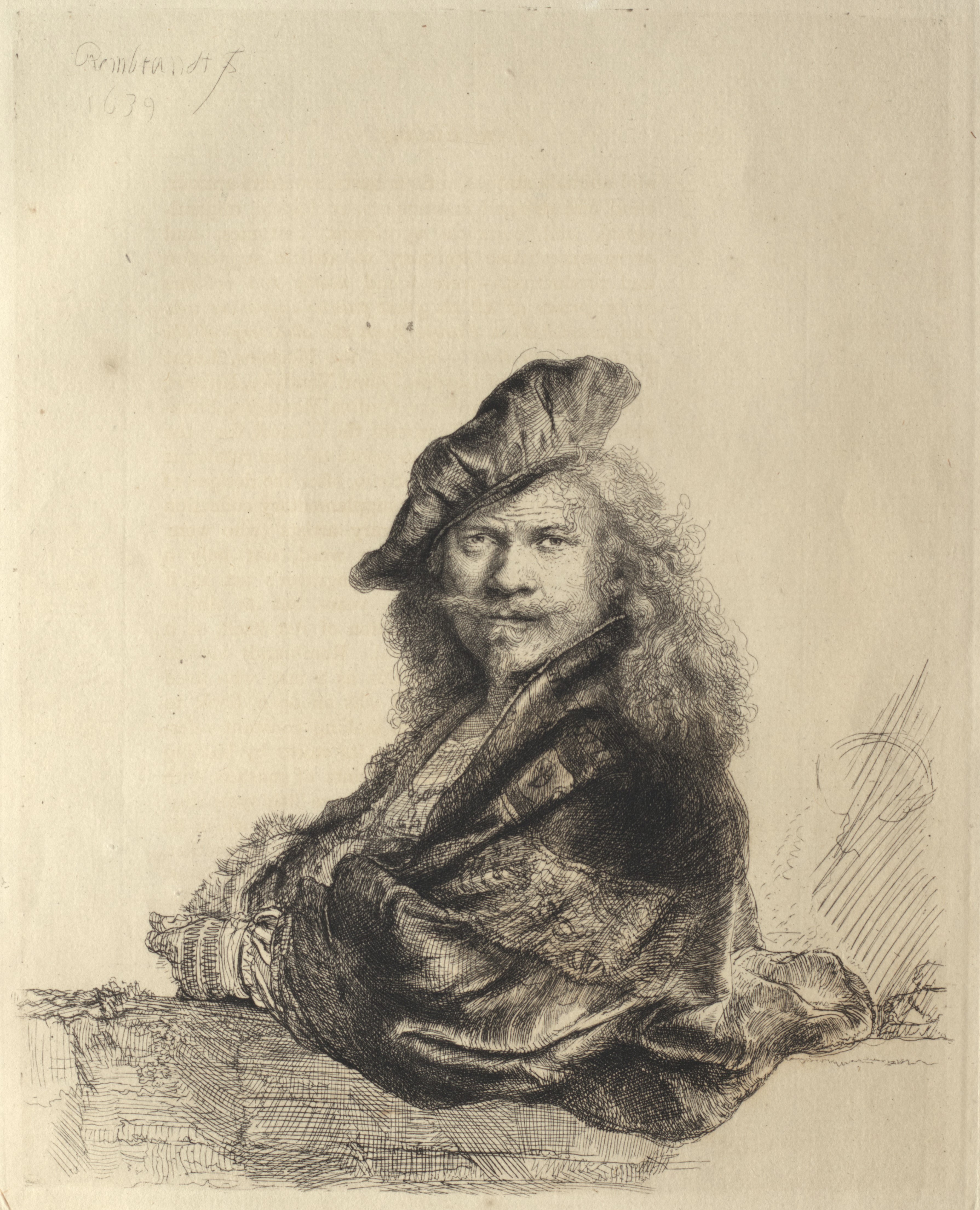
Figure 1
Self-Portrait Leaning on a Stone Sill, 1639.
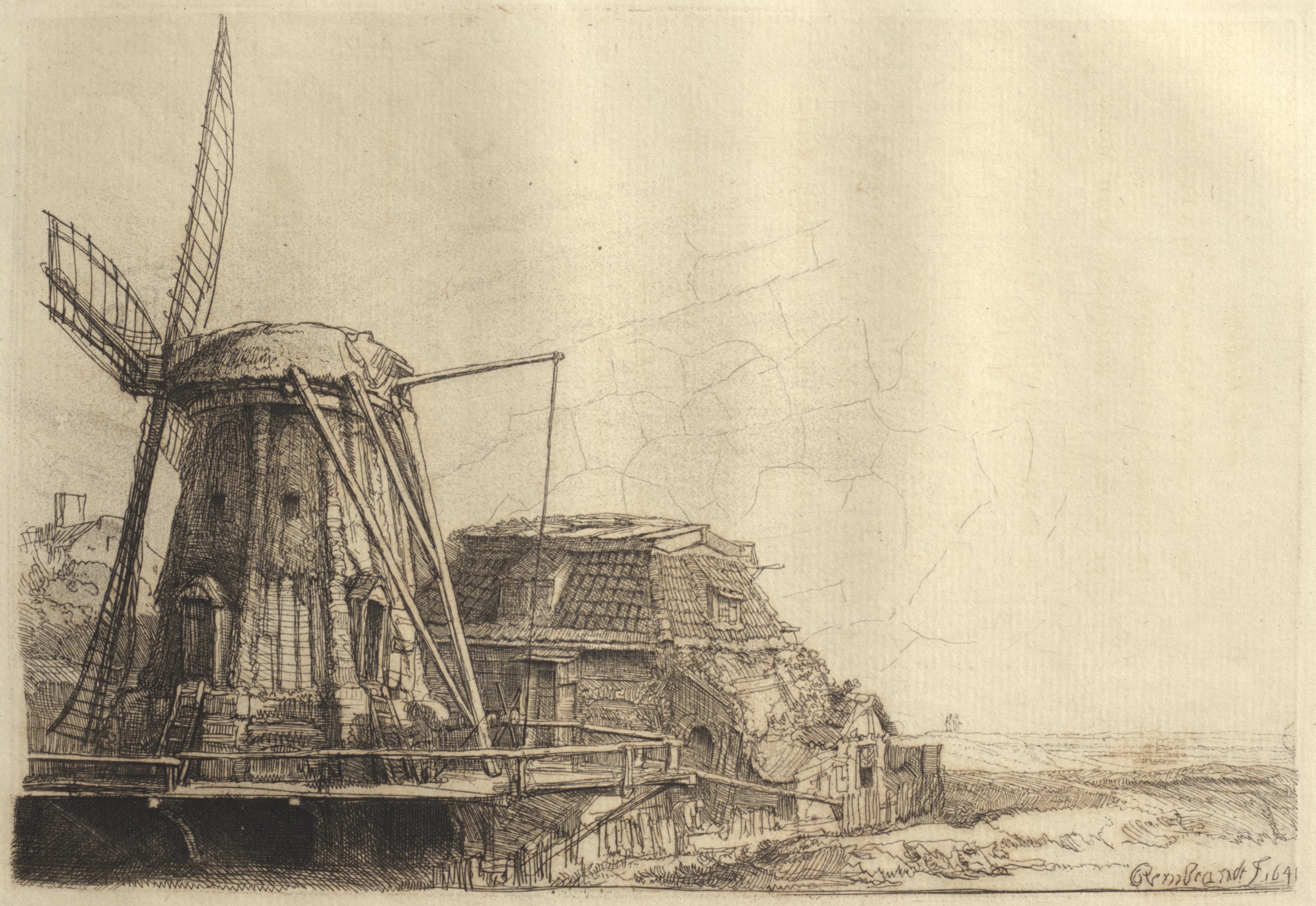
Figure 2
The Mill, 1641.
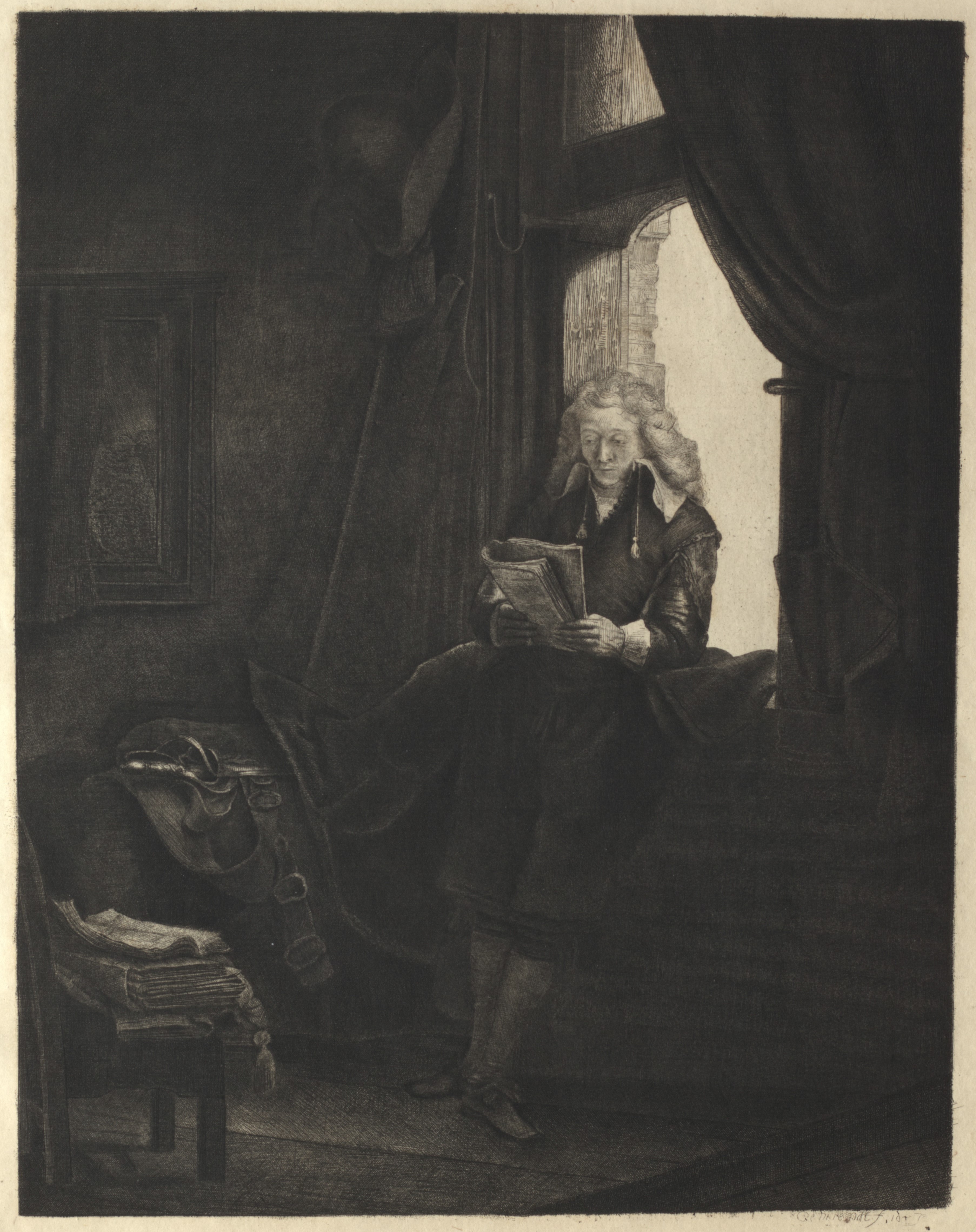
Figure 3
Jan Six without Inscription, 1647.
A countermark is the secondary mark placed on the half of the mould opposite the main watermark. In these three impressions, the principal watermark does not survive, but the countermark’s form corresponds to those associated with mills active in the Zaan region. The chain-line spacing of the three sheets falls within the expected range of Dutch papermaking from the mid-seventeenth century, and all preserve strong surface texture rather than the flattening often found in impressions printed after prolonged storage or extensive reprinting.
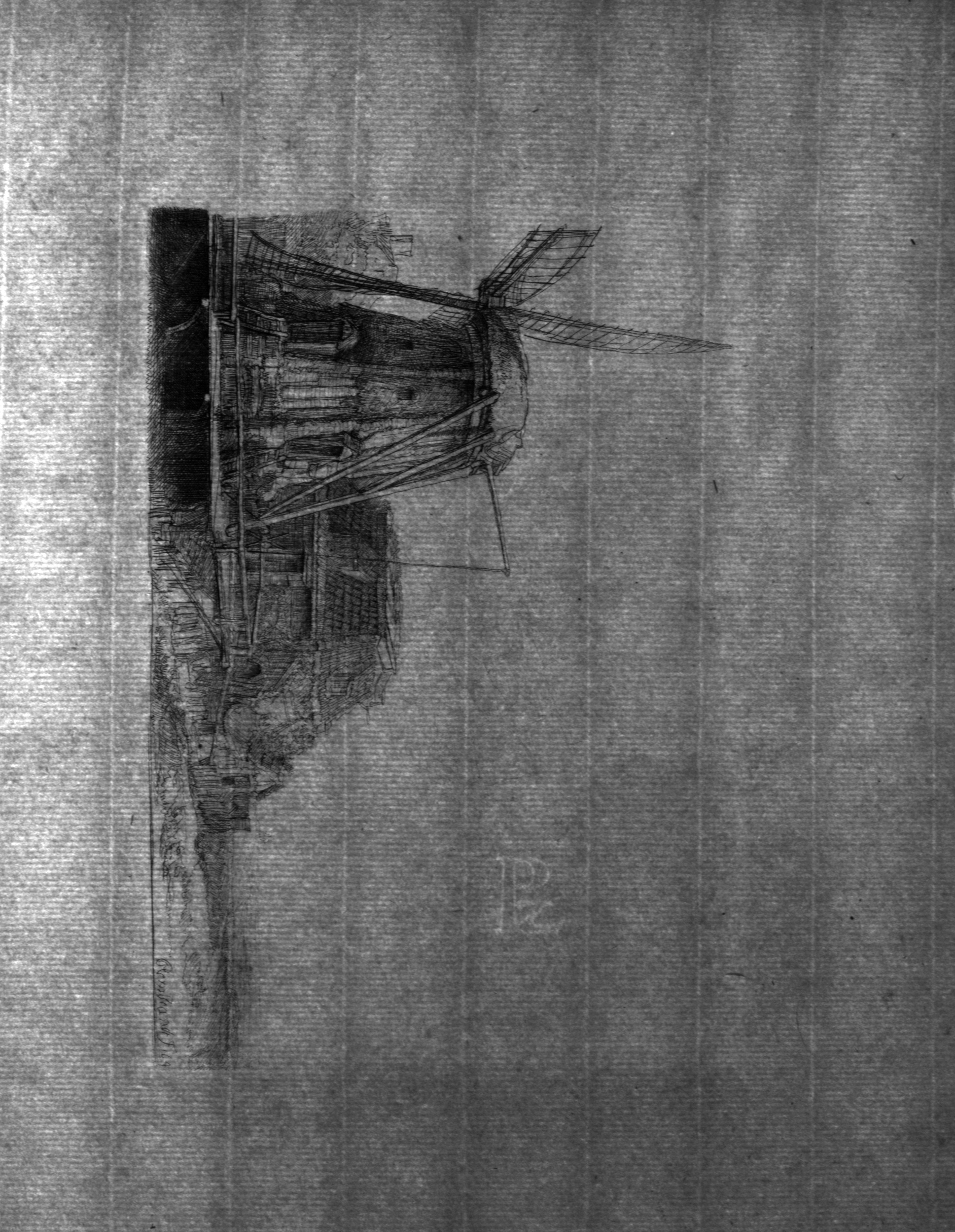
Figure 4
Countermark associated with the Van der Ley paper mill, recorded in transmitted light to document structure and position on the sheet.
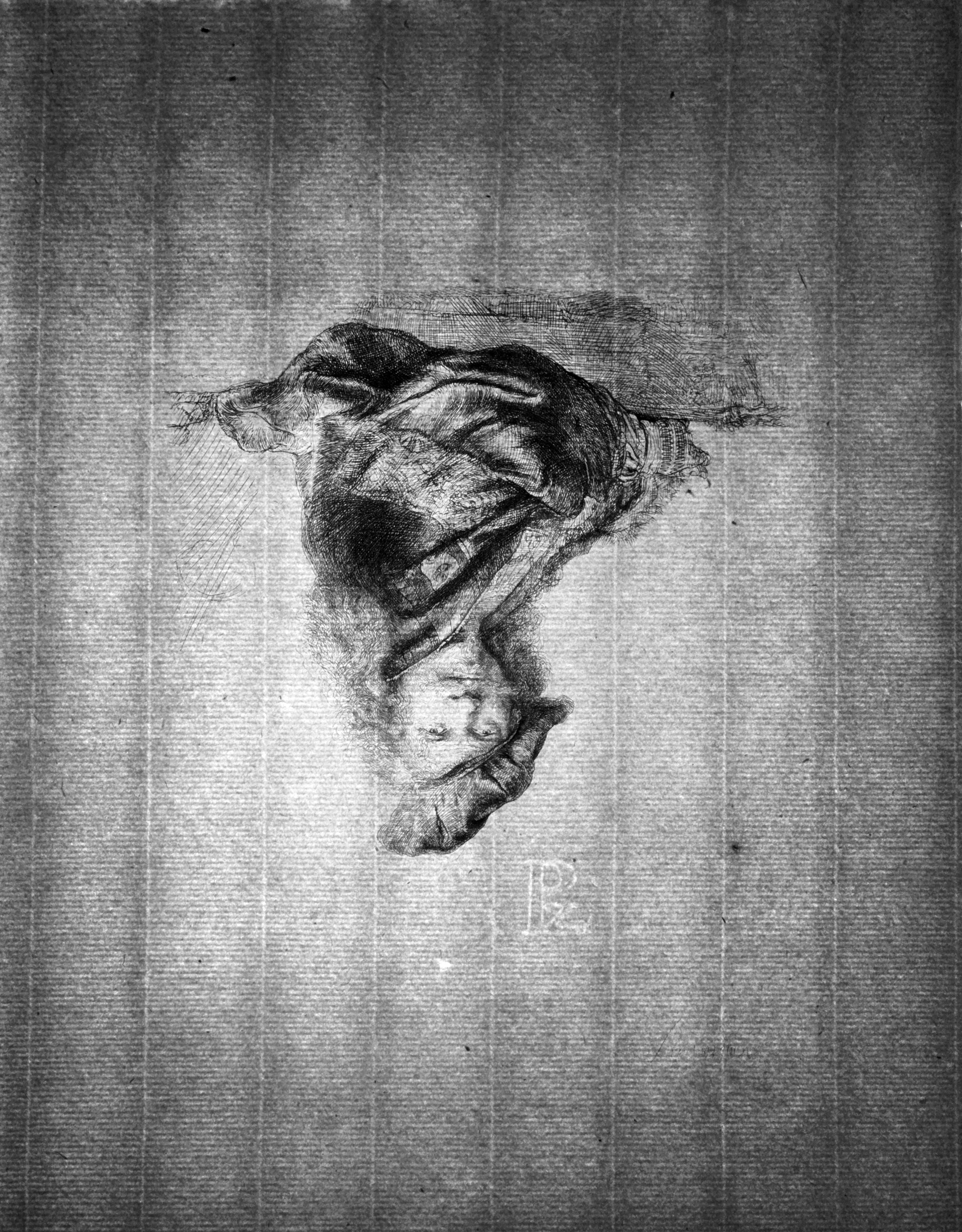
Figure 5
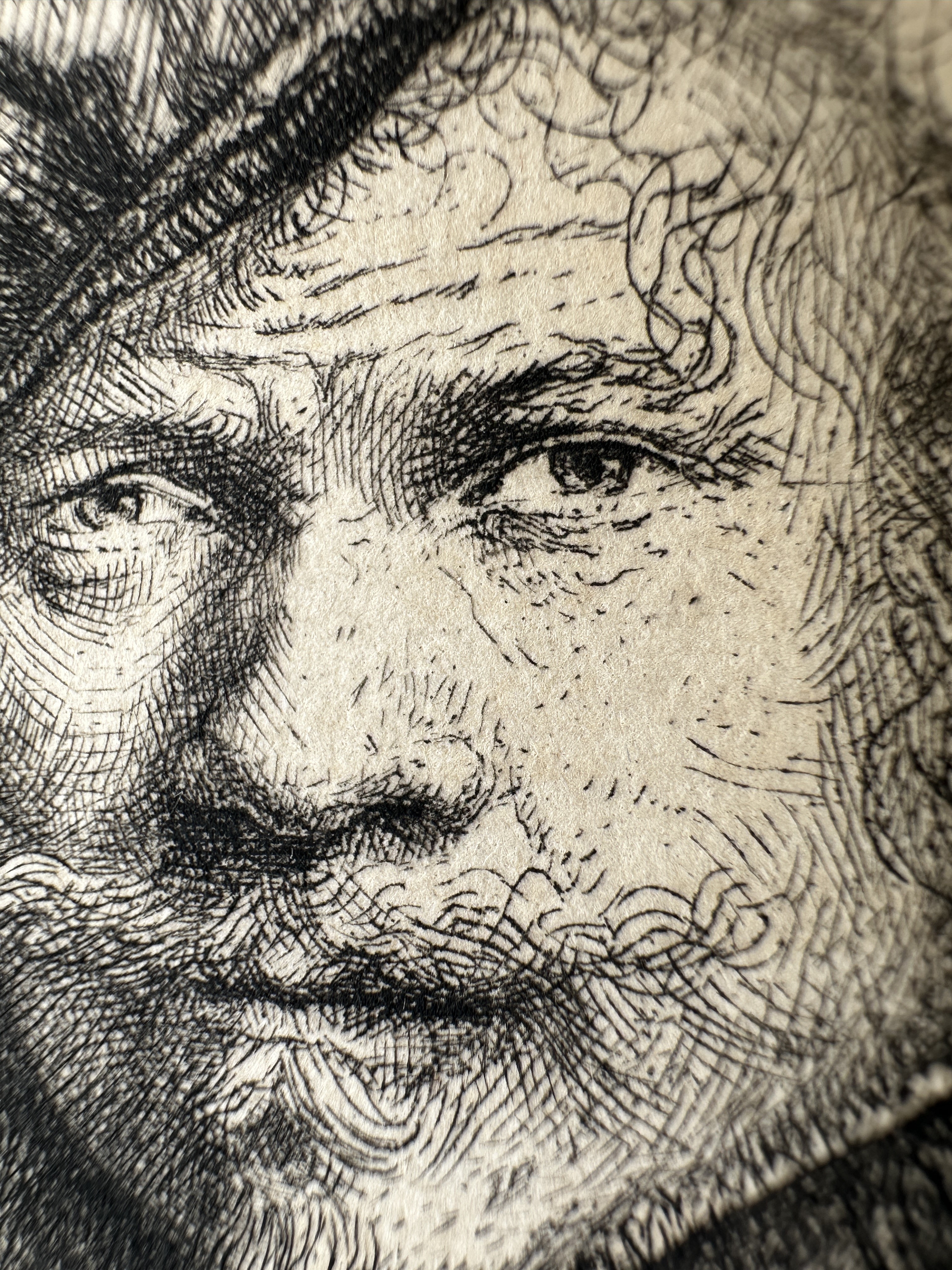
Detail from Self-Portrait Leaning on a Stone Sill showing preserved burr along the contour of the face and beneath the nose.
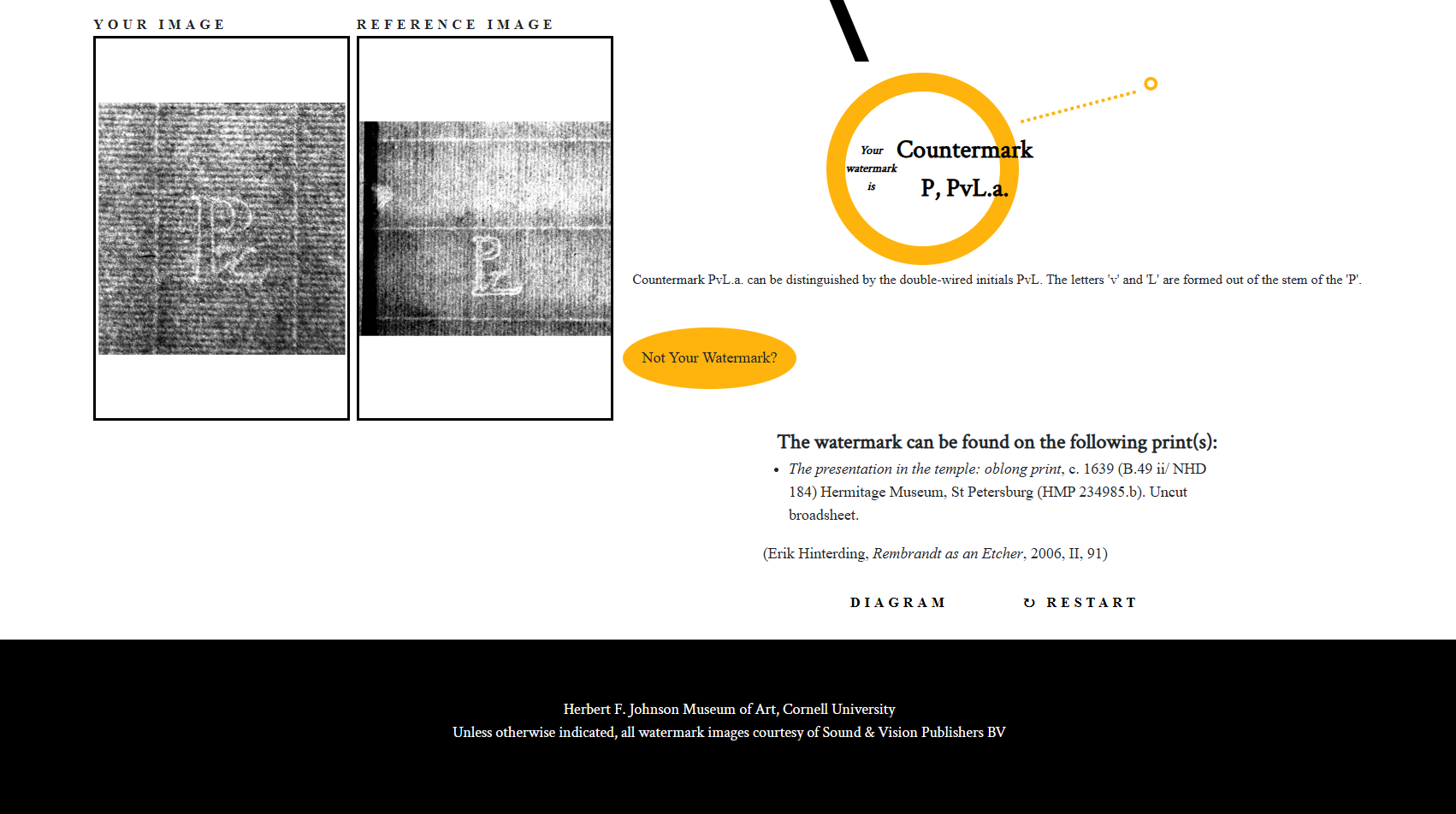
Source: Rembrandt WIRE Project, Countermark Database, PvL.a, based on Erik Hinterding, Rembrandt as an Etcher (2006), II, p. 91.
The presence of the same countermark across impressions dated 1639, 1641, and 1647 demonstrates that the Van der Ley paper circulated within Rembrandt’s workshop during the 1640s. The identification of the mark as type PvL.a confirms that the paper belongs to a documented group of Dutch sheets already in use during the artist’s lifetime.
Crucially, these impressions preserve rich burr in the darker etched passages. Burr is the fragile micro-relief created when the copperplate retains raised edges along deeply bitten lines. As Stijnman has shown, burr diminishes rapidly: it is lost after only a small number of impressions and continues to weaken even when plates are stored unused due to oxidation and handling.
To uphold the highest technical standards, the prints were subjected to digital texture analysis (GLCM). This computational approach allows us to go beyond human observation by mapping the spatial relationship of pixels at a microscopic level. The results confirm that the ink-to-paper interaction exhibits a structural complexity and high-contrast relief a 'textural fingerprint' that consistent with impressions with preserved burrs.
“The survival of burr in all three sheets strongly suggests that they were printed while the plates were still in a relatively fresh condition.”
This would be difficult to reconcile with impressions produced decades after Rembrandt’s lifetime, when the plates would likely have exhibited substantial wear. In Self-Portrait Leaning on a Stone Sill burr is visible along the contour of the face and in the shadow beneath the nose (fig. 7). In The Mill it is evident in the darker passages along the slope and in parts of the sky (fig. 8). In Jan Six without Inscription traces of burr remain in the modelling of the head and in the deeper lines of the cloak (fig. 9). These early-state characteristics, found consistently across three prints of different dates, suggest that the Van der Ley countermark does not belong exclusively to posthumous printings.
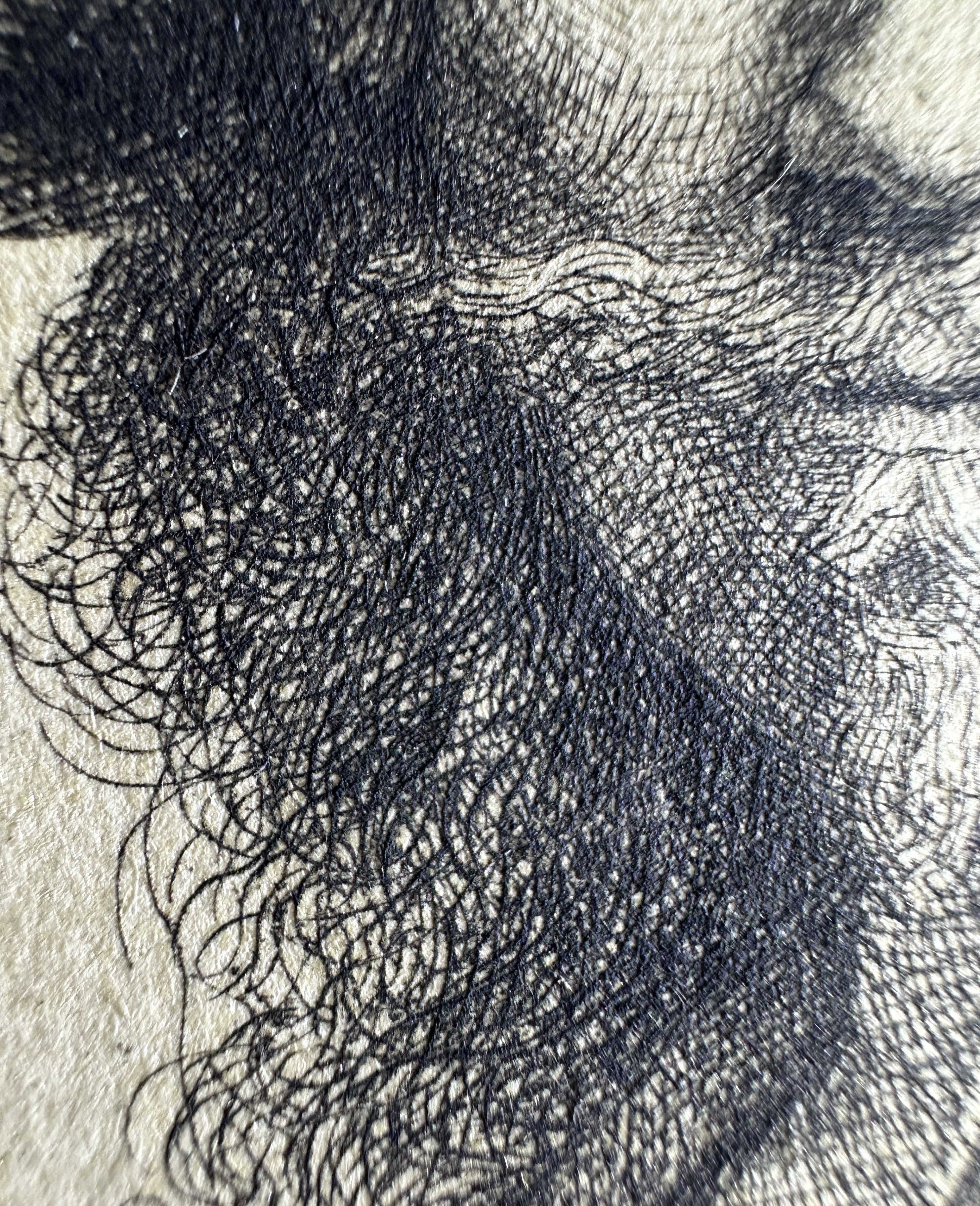
Figure 7
Self-Portrait Leaning on a Stone Sill: burr along facial contour and the shadow beneath the nose.

Figure 8
The Mill: darker passages along the slope and parts of the sky where burr remains visible.

Figure 9
Jan Six without Inscription: surviving burr in the modelling of the head and deeper lines of the cloak.
Sir Francis Seymour Haden. In his 1879 technical analysis, Haden draws a critical distinction between the freshly engraved plate and its subsequent wear, using the portrait of Burgomaster Six as a principal example of Rembrandt's mastery.
Haden argues that the artist's intention is most faithfully conveyed while the plate retains its physical integrity, reflected in the strength of the printed lines and the depth of tone. As the plate undergoes successive impressions, its condition changes and the resulting impressions progressively lose clarity and force.
The preservation of strong line relief and rich tonal passages in the Van der Ley paper analyzed here therefore supports the interpretation that these impressions were printed while the plate remained in a relatively fresh condition. This observation challenges the traditional classification of these prints as late posthumous editions and instead places them within a period of circulation much closer to the master's lifetime.
The presence of the Van der Ley countermark in impressions that retain an active burr, a coherent ink structure, and transitory plate features provides a definitive material indication of the paper’s use during the operational life of the copperplate. These characteristics correspond to impressions produced while the plate was still undergoing refinement and active state changes, rather than to a later or posthumous phase of printing where such delicate relief would have been lost.
Paper was not a resource reserved for a single chronological moment; it formed part of the working stock available to both the printer and the artist. The recurrence of the Van der Ley countermark across impressions associated with different stages of plate development demonstrates that this paper circulated within the active workshop environment. Its use as a practical printing support coincides with the period of peak production and creative adjustment.
The documented visual discrepancies in specific details of the dagger and the curtain illustrate the evolution of the copper plate's physical state. These details (Figs. 10.a–10.b) establish a clear chronological context, showing that Van der Ley paper captures the plate in a state of transformation, preserving the texture and feel of the original work.
Taken together, these observations support the interpretation that Van der Ley paper was employed in the workshop under Rembrandt’s direct supervision. As part of the standard materials available for printing, its presence validates the early nature of the impression. These findings effectively decouple the Van der Ley watermark from the assumption of late or posthumous use.
The side-by-side comparison between the private print and the Rijksmuseum reference (inv. RP-P-1962-111, Figs. 11.a–11.b) provides visual evidence of the morphological evolution of the plate.

Figure 10a
In this area, the private print (left) shows incomplete elements of the dagger; the lines are shorter, the design is "open," and it lacks defining strokes that are present in the institutional version.

Figure 10b
The curtain area is completely devoid of decorative ornamentation. Only the basic structure of the design is visible.
A comparison with an impression in the Rijksmuseum, Amsterdam, inv. RP-P1962-90 (fig. 11) offers useful context. That sheet preserves a similar density of tone and line relief in the darker areas, particularly along the slope and lower sky, supporting the interpretation that the impression discussed here was likely printed while the plate retained much of its original depth. Institutional catalogues note that later impressions preserved at the Rijksmuseum and at the Hermitage generally show plate flattening, softened line quality, and reduced burr features absent from the present group.
Side-by-side comparison intended to allow direct visual assessment of tonal density, line relief, and survival or reduction of burr in darker passages.
%20vs.%20Rijksmuseum%20RP-P1962.jpg)
Private Collection — Figure 11a
Greater tonal depth and stronger surviving relief in darker passages, particularly along the slope and lower sky.
%20and.jpg)
Rijksmuseum, inv. RP-P1962-90 — Figure 11b
Institutional comparison used here as reference context for plate depth, tonal retention, and later-state wear patterns.
These descriptions provide a reference framework for understanding the early-state character of the three impressions with the Van der Ley countermark discussed here, although the present observations are based solely on direct examination and on the documented comparison with the Rijksmuseum impression.
The presence of the same countermark across prints dating from 1639, 1641, and 1647 aligns with typical patterns in seventeenth-century Amsterdam, where artists relied on mixed stocks of paper purchased according to availability rather than strict chronological batches from a single mill. The consistency of material features particularly the preserved burr suggests that the Van der Ley paper used for these three impressions circulated earlier than traditionally assumed and was therefore available in Rembrandt’s workshop throughout the 1640s.
Notes
- In volume II of Rembrandt as an Etcher (Hinterding, 2006, p. 91), it is explained that the burr is a fragile metal structure raised by the burin or drypoint when etching the plate. During printing, the pressure of the press progressively flattens this burr, reducing its ability to hold ink. As a result, only a limited number of high-quality prints can be obtained before the burr either disappears completely or becomes so flattened that it no longer produces optimal effects.
- The burr is a very fragile structure of raised metal. It is crushed by the pressure of the press during the printing process. Only a limited number of high-quality impressions can be taken before the burr disappears completely — Ad Stijnman, Engraving and Etching 1400–2000: A History of the Development of Manual Intaglio Printmaking Processes, Brill / Hes & De Graaf, 2012, p. 244, section on drypoint and burin.
- Rembrandt WIRE Project, Countermark Database, type PvL.a, The watermark can be found on the following print(s) The presentation in the temple: oblong print, c. 1639 (B.49 ii/ NHD 184) Hermitage Museum, St Petersburg (HMP 234985.b). Uncut broadsheet.Erik Hinterding, Rembrandt as an Etcher, 2006, II, 91
Bibliography
- Sir Francis Seymour Haden, About Etching: Part I. Notes by Mr. Seymour Haden on a Collection of Etchings and Engravings (London, 1879), pp. 30–31.
- Erik Hinterding, Rembrandt as an Etcher: The Practice of Production and Distribution, 3 vols., Ouderkerk aan den IJssel: Sound & Vision, 2006, vol. II, p. 91.
- Rembrandt WIRE Project, Department of European & American Art, Cornell University. Ongoing digital watermark census and imaging research.
- Ad Stijnman, Engraving and Etching 1400–2000: A History of the Development of Manual Intaglio Printmaking Processes, Brill / Hes & De Graaf, 2012, p. 244 Houten: HES & De Graaf, 2012.